Limma
In de muziektheorie is het limma (Grieks: λεῖμμα (leimma), rest) de pythagorese diatonische halve toonafstand, een interval met de verhouding 243:256. Het limma vormt samen met de apotome, de chromatische halve toonafstand, de pythagorese hele toonafstand.
Het limma is het verschil tussen de reine kwart en de pythagorese grote terts (ditonus). De frequentieverhouding 243:256 volgt dus uit de verhouding 3:4 voor de kwart en 64:81 voor de ditonus:
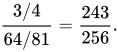
Naast dit standaardlimma kent men ook het 'klein' en het 'groot limma'.
Pythagorees systeem
Het systeem van Pythagoras is gebaseerd op de reine kwint, dus met een verhouding 2:3. Een grote terts wordt berekend door twee hele toonafstanden van 8:9 te stapelen: 8:9 × 8:9 = 64:81.
Het limma ontstaat ook als het 'verschil' (verhouding) tussen de stapeling van 3 octaven (bijvoorbeeld c-c'-c") en de stapeling van 5 kwinten (c-g-d'-a'-e"-b"). Dan is de verhouding tussen c" en b":

Het limma is een didymische komma kleiner dan de natuurlijke halve toon:
- Natuurlijke halve toonafstand = 15:16
- Didymische komma = 80:81
- Limma: 243:256 = (15:16) : (80:81)
Klein limma
Het klein limma is het verschil tussen een grote hele toon en een diatonische halve toonafstand. De naamgeving stamt van Marpurg.
- Grote hele toonafstand: 8:9
- Diatonische halve toonafstand: 15:16 = 120:128
- Klein limma (vb. des-d) = 128:135
Groot limma
Het grote limma is slechts theoretisch van belang en wordt in de praktijk zelden gebruikt. Het bestaat uit de verhouding 25:27, en is de som van de kleine diesis en het kleine limma (125:128)x(128:135)=25:27
 ·
·  ·
· 
Content Disclaimer
Informasi ini disarikan dari Wikipedia dan disajikan kembali untuk tujuan edukasi. Konten tersedia di bawah lisensi CC BY-SA 3.0. Kami tidak bertanggung jawab atas ketidakakuratan data yang bersumber dari kontribusi publik tersebut.
- The information displayed on this website is sourced in part or in whole from Wikipedia and has been adapted for the purpose of restating it. We strive to provide accurate and relevant information, however:
- There is no guarantee of absolute accuracy. Wikipedia is an open, collaborative project that can be edited by anyone, so information is subject to change.
- It is not intended to constitute professional advice. The content displayed is for informational and educational purposes only. For important decisions (e.g., medical, legal, or financial), please consult a professional.
- Content copyright. Wikipedia is licensed under the Creative Commons Attribution-ShareAlike License (CC BY-SA). This means that content may be reused with appropriate attribution and shared under a similar license.
- Responsible use. Any risk arising from the use of information from this website is entirely the responsibility of the user.